Overview
Description: The Translational Neuro Engineering Lab at Scuola Superiore Sant’Anna is studying several neuromodulation techniques in animal models. Because these applications interface directly with the peripheral nervous system, they require lower stimulation levels and finer resolution than the original COSMIIC system design for muscular activation.
Contributors: Filippo Castellani, Alice Gianotti, Francesco Iberite, Silvestro Micera
Attributions: Supported by the NIH SPARC HORNET program, the COSMIIC grant team is funded by main award U41NS129436-03 and is interacting with the Scuola Superiore Sant’Anna as an early adopter.
Goal
The goal was to reduce the stimulation amplitude range from 0.1 mA - 20 mA at 0.1 mA resolution to 10 uA - 2000 uA at 10 uA resolution.
Design Thinking
Given the PG4 version in use (PG4D module circuit) and the fact that the change is intended to be permanent, a hardware modification is more appropriate than a firmware change. Future versions of the PG4 should make amplitude-range adjustments easier to implement in firmware.
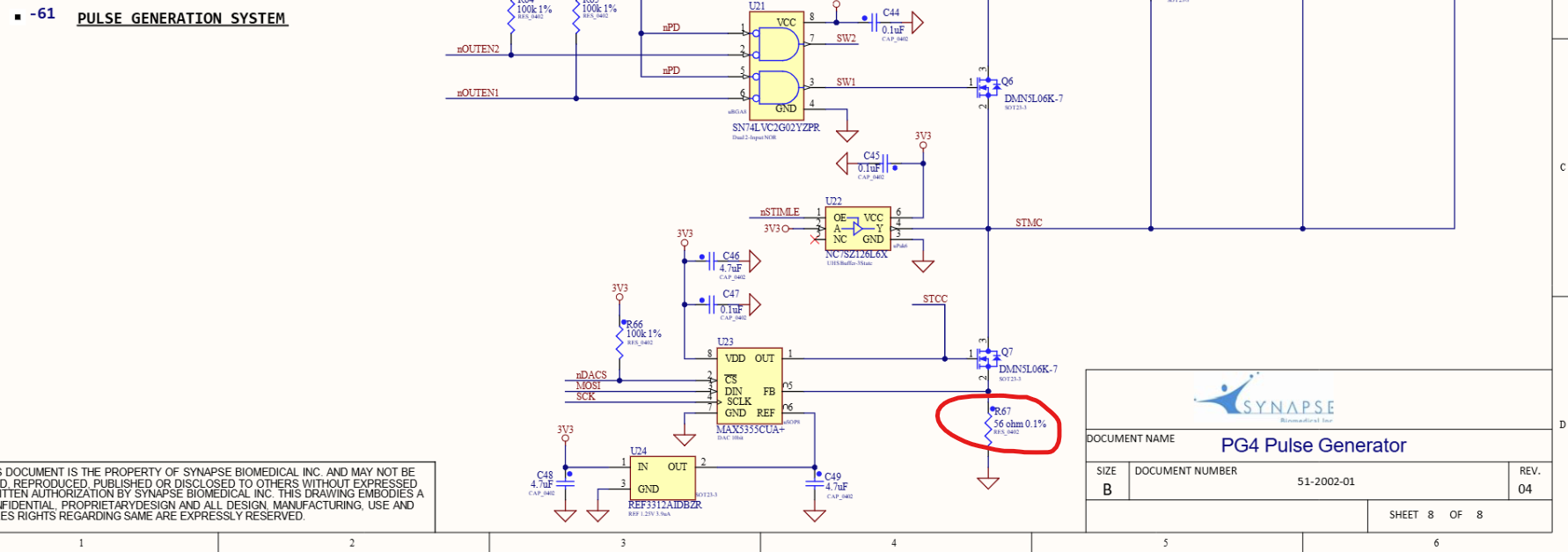
Start with the circuit schematics of the PG4 module in the Implantables-PG4-Hardware repository found on the COSMIIC GitHub. The picture above shows the stimulation output stage and has R67 circled. The current output is based on an input voltage divided by that R67. The current range and resolution will scale inversely with changes made to R67. To scale the current amplitude range down by 10, R67 was swapped with a resistor of 10x the resistance value (56 Ω x 10 = 560 Ω). The next version of the PG4 (PG4E module circuit) will be easier to make firmware changes and use the full resolution of the DAC. That will be ready in late 2026.
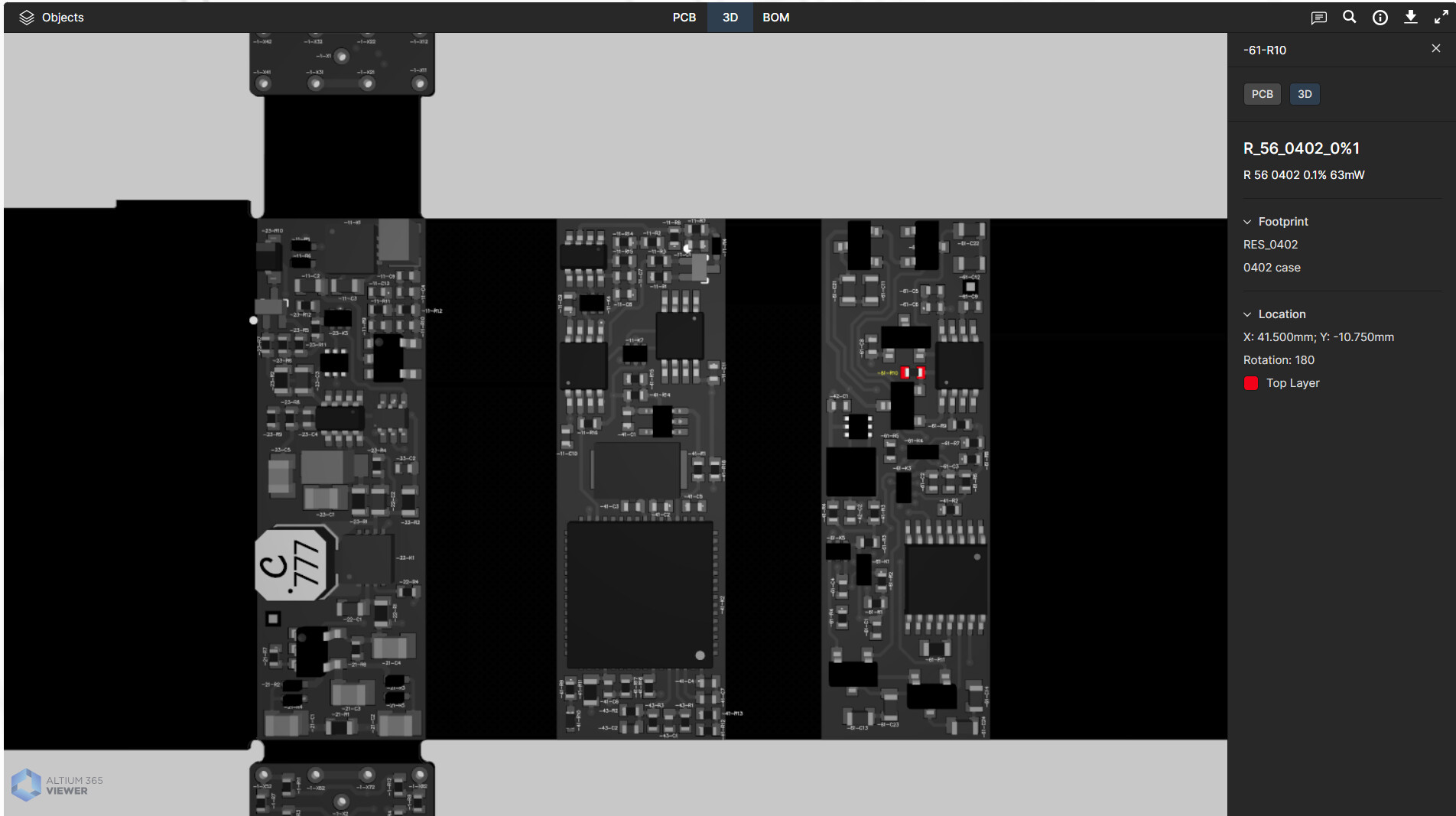
View of that resistor’s location, highlighted in red, using a
.pcbdocviewer. Metadata confirms that it is a 56 Ω resistor.
Completed Modification
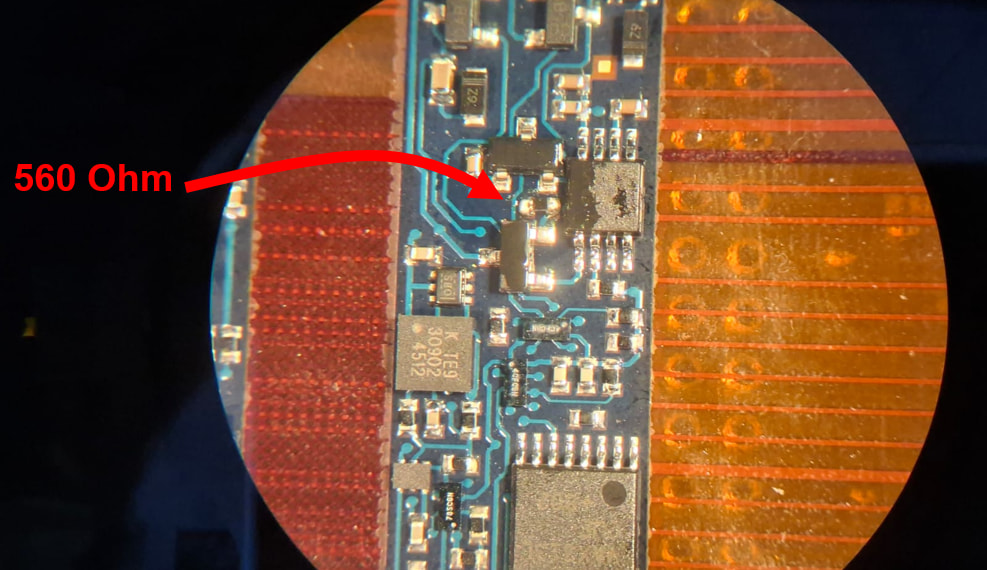
View of the board location after successfully removing the 56 Ω SMD resistor and replacing with a 560 Ω resistor.
Forks of Repository
No modifications were made to the firmware or hardware repositories for the modules involved. Scale of stimulation parameters is tracked accordingly in team’s software.